NAT gateways provide network address translation (NAT) with 20 Gbit/s of bandwidth for cloud servers (BMS) or for servers in on-premises data centers that connect to a VPC through Direct Connect or VPN. A NAT gateway enables cloud and on-premises servers in a private subnet to share an EIP to access the Internet or provide services accessible from the Internet. A NAT gateway enables cloud servers to access services in on-premises networks or other VPCs.
NAT Gateway offers source NAT (SNAT) and destination NAT (DNAT).
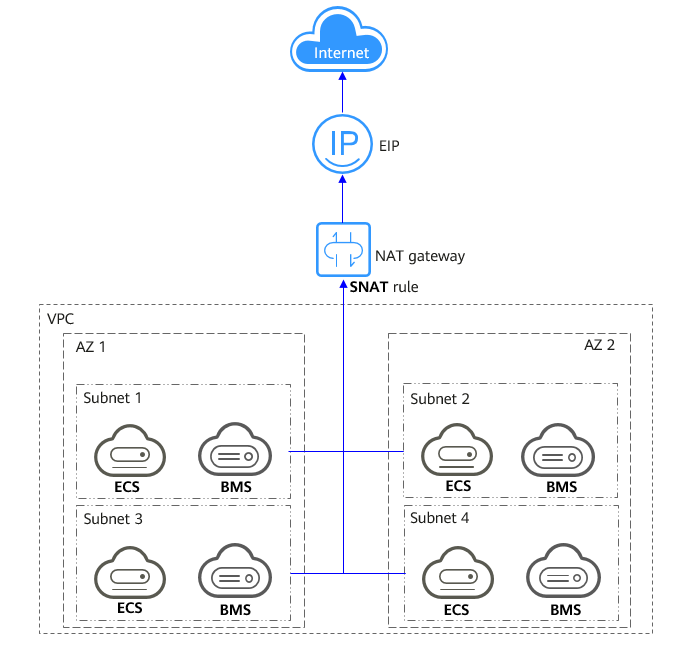
- SNAT translates private IP addresses into an EIP so that cloud servers across AZs can share an EIP to access the Internet.
Figure 1 shows how an SNAT rule works.
Figure 1 NAT gateway with an SNAT rule
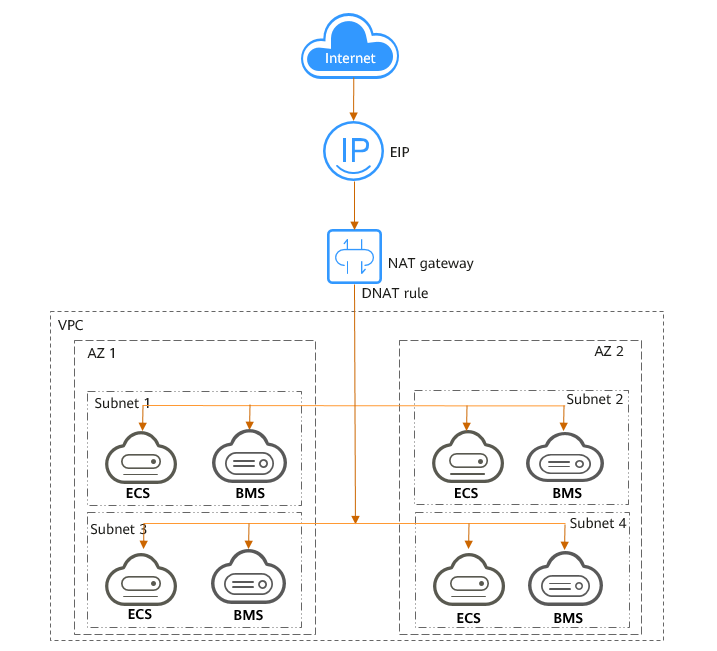
- DNAT enables servers in a VPC, regardless of whether they are in the same AZ, to share an EIP to provide services accessible from the Internet. With an EIP, a public NAT gateway forwards the Internet requests from only a specific port and over a specific protocol to a specific port of a server, or it can forward all requests to the server regardless of which port they originated on.
Figure 2 shows how a DNAT rule works.
Figure 2 NAT gateway with a DNAT rule
Public NAT gateways are used to provide NAT.
Public NAT Gateways
A public NAT gateway enables cloud and on-premises servers in a private subnet to share an EIP to access the Internet or provide services accessible from the Internet. Cloud servers are ECSs and BMSs in a VPC. On-premises servers are servers in on-premises data centers that connect to a VPC through Direct Connect or Virtual Private Network (VPN). A public NAT gateway supports up to 20 Gbit/s of bandwidth.
Public NAT gateways offer source NAT (SNAT) and destination NAT (DNAT).
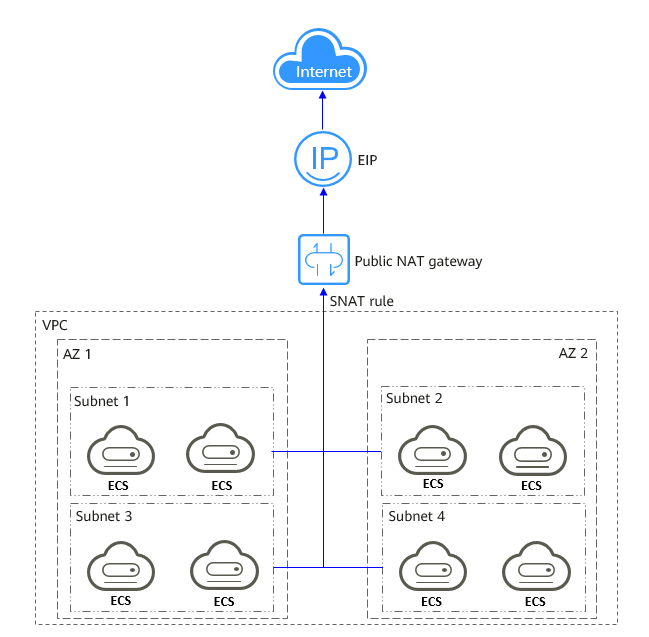
- SNAT translates private IP addresses into an EIP so that cloud servers across AZs can share an EIP to access the Internet.
Figure 3 shows how an SNAT rule works.
Figure 3 NAT gateway with an SNAT rule
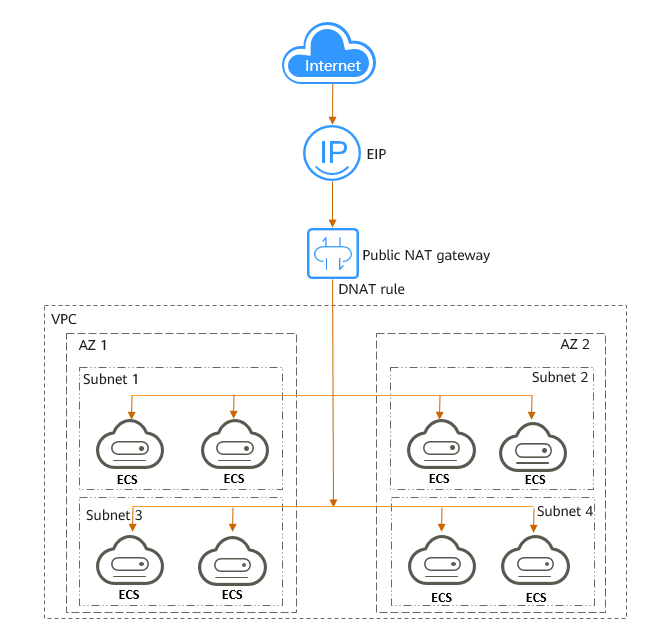
- DNAT enables servers in a VPC, regardless of whether they are in the same AZ, to share an EIP to provide services accessible from the Internet through IP address mapping or port mapping.
Figure 4 shows how a DNAT rule works.
Figure 4 NAT gateway with a DNAT rule
How Do I Access the NAT Gateway Service?
You can access the NAT Gateway service through: Log in to the management console and choose NAT Gateway from the service list. If you need to integrate NAT Gateway on the cloud platform into your own system, use APIs to access NAT Gateway.