Generally, Redis instances save and obtain data in the data layer closer to application services, which consumes the network bandwidth. Rate limits may occur when the instance bandwidth is insufficient, causing increased service latency or client connection exceptions. Currently, the Redis instance bandwidth can be adjusted on the console for DCS Redis 4.0 and later instances.
Notes and Constraints
- This function is available only for instances in the Running state.
- The adjustment range of bandwidth per shard is from the shard's assured (default) bandwidth to its maximum bandwidth. Generally, the maximum bandwidth per shard is 2,048 Mbit/s when the physical machine of the instance node has sufficient resources.
- Set the target bandwidth to a multiple of 8. Otherwise, the value will be automatically rounded down to a multiple of 8 after the order is submitted.
- Changed bandwidth is pay-per-use only, and charged by hour. Check your fee changes.
Adjusting DCS Instance Bandwidth
- Log in to the DCS console.
- Click
 in the upper left corner and select a region and a project.
 - In the navigation pane, choose Cache Manager.
- On the Cache Manager page, click the name of the DCS instance you want to configure.
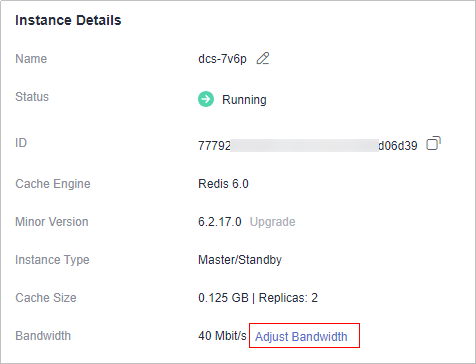
- In the Instance Details area of the DCS instance, click Adjust Bandwidth next to Bandwidth.
Figure 1 Adjusting bandwidth
- On the Adjust Bandwidth page, set bandwidth parameters.Note
- Set the target bandwidth to a multiple of 8. Otherwise, a value rounded down to a multiple of 8 will be automatically used after the order is submitted. For example, if you set the bandwidth to 801, 800 will be used instead.
- Price shown on the change page is only the fee of the additional bandwidth.
- The additional bandwidth is pay-per-use, and charged by hour.
- You can adjust the bandwidth whenever as required. If you perform multiple bandwidth changes in a billing period (one hour), you will be billed according to highest bandwidth in the period. For example, if you have changed the bandwidth of a DCS Redis instance from 256 Mbit/s (default) to 2,048 Mbit/s, and changed the bandwidth again to 512 Mbit/s in the same billing period, you will be billed at the price of 2,048 Mbit/s bandwidth.
- Manual
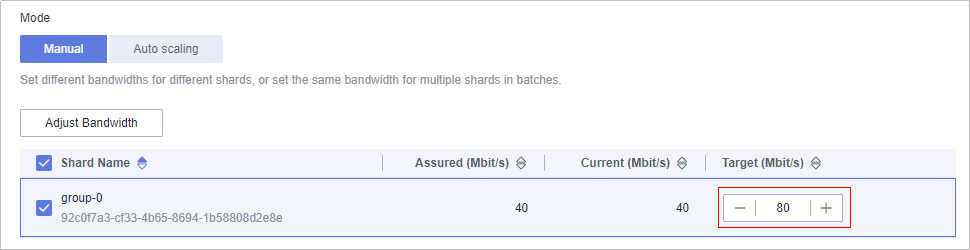
- Set target bandwidth. For cluster instances with multiple shards, specify the target for each of them, or select the desired shards and click Adjust Bandwidth.
Figure 2 Manually setting target bandwidth
- Confirm the bandwidth and fees, check Authorization, and click Submit.
When the bandwidth adjustment task is in the Successful state, the new bandwidth is used.
- Set target bandwidth. For cluster instances with multiple shards, specify the target for each of them, or select the desired shards and click Adjust Bandwidth.
- Auto scaling
- Enable Auto Bandwidth Increase and set the policies as required, as shown in Table 1.
Bandwidth increases automatically (up to 2,048 Mbit/s per shard) based on scaling policies. Automatic scaling overrides manual adjustments.
Figure 3 Setting auto bandwidth increase policies
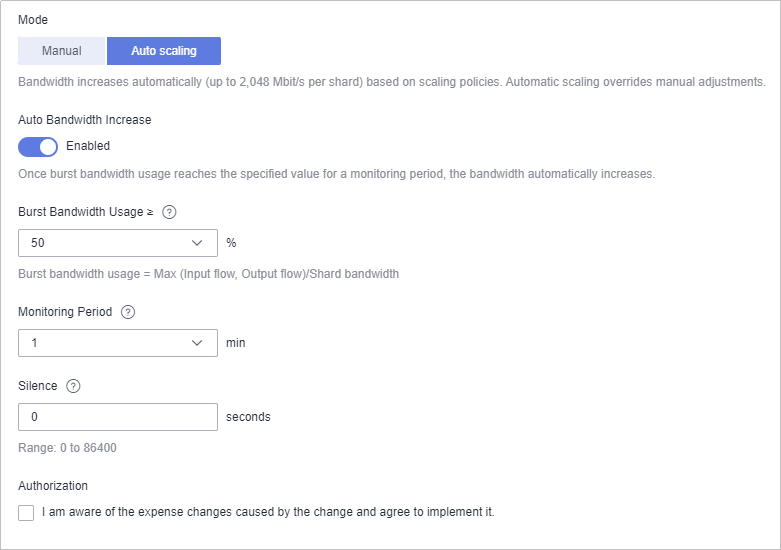
Table 1 Setting auto bandwidth increase policies Policy
Description
Burst Bandwidth Usage ≥
Burst bandwidth usage threshold for bandwidth increases.
Calculation:
Burst bandwidth usage = Burst used bandwidth/Shard bandwidth. The value of "Burst used bandwidth" uses the larger metric between Output Flow and Input Flow.
Target:
When the burst bandwidth usage of an instance shard reaches the threshold, the shard bandwidth is automatically scaled up. As a result, the burst bandwidth usage is reduced to (its threshold minus 10%).
For example, if this threshold is set to 70%, the shard bandwidth will be automatically increased when the burst bandwidth usage reaches 70%. As a result, the burst bandwidth usage decreases to 60%. Therefore, the shard bandwidth after the scaling equals the burst bandwidth usage divided by 60%.
Monitoring Period
Monitoring period of bandwidth increases, in minutes. Default: 1
For example, if the monitoring period is set to 1 minute, the bandwidth data is monitored within 1 minute.
Silence
Interval between increases, in seconds. Default: 0
The silence time avoids consecutive automatic bandwidth increases.
- Confirm the bandwidth parameters, check Authorization, and click Submit.
- Enable Auto Bandwidth Increase and set the policies as required, as shown in Table 1.
Checking Assured Bandwidth and Adjusted Bandwidth
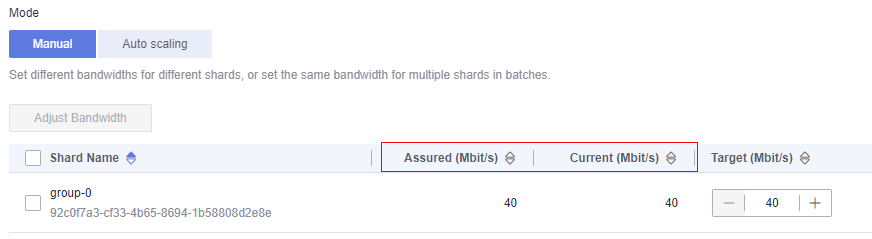
On the page for manually adjusting the bandwidth, you can view Assured and Current bandwidth of each shard. Current displays the latest bandwidth.
Figure 4 Viewing bandwidth
The relationship between the instance bandwidth and the bandwidth of a single shard is as follows: For example, there is a cluster instance with three shards. The adjusted bandwidth of each shard is 800 Mbit/s, and the total bandwidth of the cluster instance is 2,400 Mbit/s.