DataArts Insight allows you to create a word cloud, which is a colorful graphic made up of words that resemble a cloud. It is used to display large amounts of textual data. This section describes how to create a word cloud chart.
Notes and Constraints
- At least two fields are required for a dimension.
- At least one field is required for a metric.
Prerequisites
- A project has been created by referring to Creating a Project.
- A data source has been connected by referring to Creating a Data Source.
- A dataset has been created by referring to Creating a Dataset.
- A dashboard has been created by referring to Creating a Dashboard.
Procedure

- Click Update. The system automatically updates the chart.
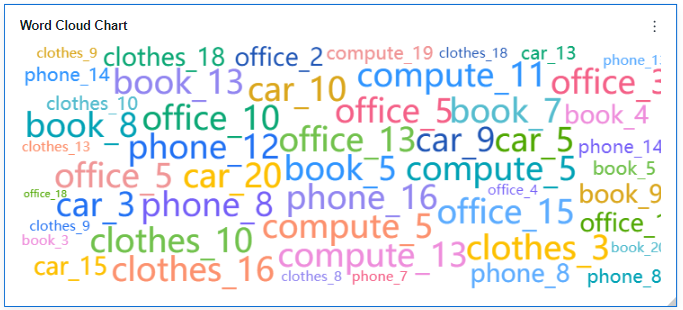
Figure 1 Word cloud chart
Field
Set the fields of the word cloud chart.
- In the right pane of the dashboard creation page, click Field. Select the required dimension and metric.
- Set a filter.
- Drag dimension and metric fields to the Filter area.
- Click
 next to a field in the Filter area.
 - In the displayed Set Filter dialog box, set the parameters and click OK.
Table 1 Filter parameters Type
Parameter
Description
String
Condition
Filter Mode: The options are Condition and Enumeration.
Condition Type: The options are And condition and Or condition.
Filter Condition: The options are Exact match, Contain, Start with, End with, Not match, Not contain, Null, and Not null.
Enumeration
Query Mode: The options are Single-select and multi-select.
Filter Condition: The options are >, ≥, <, ≤, =, ≠, Null, and Not null.
Metric
Condition Type
The options are And condition and Or condition.
Filter Condition
The options are >, ≥, <, ≤, =, ≠, Null, and Not null. You can select Before aggregation and After aggregation for data.
NOTE:If you select Before aggregation, data is filtered before aggregation. If you select After aggregation, data is filtered after aggregation. For aggregation concepts, see Creating a Dataset.
You can click Create Filter Condition to set multiple filter criteria.
Date
Range value
Select a time range for filtering.
Single value
Set a single time for filtering.
Condition
You can select And condition or Or condition as the condition type and select filter condition like >, ≥, <, ≤, and =.
You can click Create Filter Condition to set multiple filter criteria.
- Set the maximum number of query results.
Enter the maximum number of records that can be returned in the text box. The default value is 1000.
- Set automatic refresh.
The auto refresh interval supports the following options: no refresh, 1 minute, 5 minutes, 15 minutes, and 30 minutes.
Style
Set word cloud style parameters based on Table 2 and Table 3.
Parameter | Description |
|---|---|
Card Title | Cards can be configured with or without a title. If a title is set, it will be displayed in the top left corner of the card. If the checkbox is not selected ( If the checkbox is selected ( |
Text | You can adjust the font size and color of the text. To change the font size, you can either type in the desired size or use the NOTE: Note that the input cannot be empty and must be from 14 to 32. |
Alignment | You can align the text in the card to the left or center. |
Bottom Margin | Set the distance between the word cloud title and the chart. To change the margin, you can either type in the desired margin or use the NOTE: Note that the input cannot be empty and must be from 0 to 32. |
Divider | Cards can be configured with or without a divider line. If the checkbox is not selected ( If the checkbox is selected ( NOTE: Note that the input for the style cannot be empty and must be from 0 to 8. The bottom margin can only be set after the style has been set, and the input cannot be empty and must be from 0 to 32. |
Card Background | Cards can be configured with or without a background. If the checkbox is not selected ( If the checkbox is selected ( |
Status Icon | You can customize the display style and color of the icon, which can be set to always show or show on hover. The card icon can be set to have a status or no status. If the checkbox is not selected ( If the checkbox is selected ( |


Parameter | Description |
|---|---|
Color Scheme | Set the color scheme of the word cloud, either by using the system default or selecting your own. |
Word Cloud Shape | Set the shape of the word cloud. |
Computation Mode | Set the calculation mode to either relative size or emphasis. |
Custom Word Size Range | Set the size of custom words. NOTE: If the checkbox is not selected, the system default range of 12–60 will be used. If the text size is set too large, the system will automatically adjust it to the displayable range. |
Vertical Text Display | Choose to display word groups vertically. |
Value Settings | Set the context, units, scientific notation, use of thousand separators, and decimal places for numerical values. |
Tooltip | Set the background color, dimension text, indicator text, and numerical values for the tooltip. |
Advanced
- Linkage
Click the Advanced tab and click
 next to Linkage. The Chart Linkage Settings page is displayed. Set parameters. For details, see Linkage example.
Table 4 Chart linkage configurations Parameter
Description
Filter
Select the fields to be bound first and then select the chart to be associated with them. You can select all charts on the dashboard.
Associated Charts
Link the associated charts.
- Follow bound field: When the bound field is set to A, the associated data tables filter data related to A.
- SQL placeholder: The bound field value corresponds to the value set for the SQL placeholder in the dataset.
- Initialize Query for Associated Query Control: whether the associated query control supports query initialization. If the checkbox is selected (
 ), the control supports query initialization. If the checkbox is not selected (
 ), the control does not support query initialization.Note
If you select this option, when a chart is linked to a query control and the query control does not have a default query set, the chart's data configuration will be queried during chart initialization.