Distributed architecture and microservice technologies have caused applications to become increasingly complex. This complexity results in architecture deconstruction and performance improvements. However, it also brings the challenges of difficulty locating performance problems in the production environment and long repair periods. Performance tests in advance of application launches are therefore necessary.
Cloud Performance Test Service (CPTS) provides performance tests for cloud applications using HTTP, HTTPS, TCP, or UDP. CPTS performs rapid simulation of service peaks with large numbers of concurrent users. It allows you to define the contents and time sequences of packets and supports different combinations of multiple transactions for complex scenario tests. CPTS simplifies performance pressure tests, focuses on services and performance problems, reduces costs, improves stability, optimizes user experience, and maximizes the business value of enterprises.
Figure 1 Cloud Performance Test Service (CPTS)

Functions
CPTS provides tests for HTTP/HTTPS/TCP/UDP-based applications with high user concurrency. It allows you to flexibly define multi-protocol packet contents, transactions, and test task models. CPTS also allows you to view performance statistics, such as concurrency, RPS, and response latency during or after testing. You can also create private test clusters or scale in or out resource groups for performance tests of different scales.
Multi-protocol and high-concurrency performance tests
- Quickly define standard HTTP/HTTPS/TCP/UDP packet contents. You can send pressure test traffic to different tested applications through simple adjustments.
CPTS allows you to define any fields in HTTP/HTTPS/TCP/UDP packets based on the requirements of tested applications. For example, you can configure the GET and POST methods, URLs, headers, and bodies of HTTP requests.
- Define the behavior of virtual users for different test scenarios.
Specify the interval for sending requests of the same user by setting the think time, or define multiple request packets in a transaction to set the number of requests initiated by each user per second.
- Customize the response result verification to provide more accurate standards for determining successful requests.
CPTS allows you to configure checkpoints based on your service requests. After obtaining response packets, CPTS verifies their response code and header fields. Only response packets meeting the specified conditions are considered normal responses.
Defining test task models for complex scenario tests
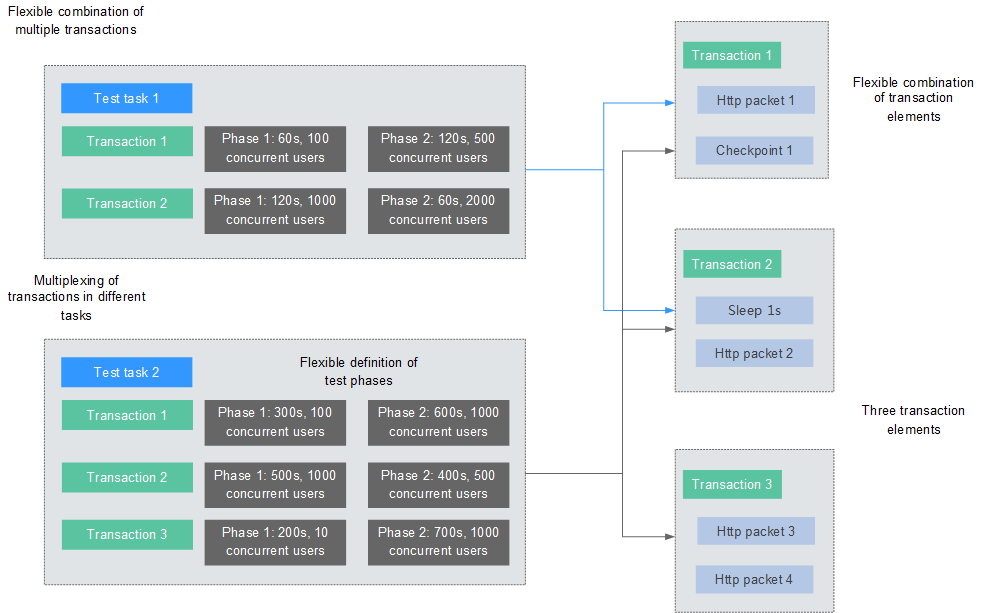
- With multiple flexible combinations of transaction elements and test task phases, CPTS allows you to test application performance in scenarios with different user operation types and concurrent user operations.
- A transaction can be used by multiple test tasks, and multiple test phases can be defined for a transaction. In each test phase, you can define the test duration, number of concurrent users and tests, as well as simulate complex scenarios with different traffic peaks and troughs.
Figure 2 Complex scenario tests
Providing professional performance test reports for easy understanding of application performance
- CPTS collects application performance statistics from multiple aspects, such as RPS, number of concurrent users, response latency, number of access requests, response verification failures, and response timeout.
- CPTS provides real-time and offline test reports for you to view and analyze test data at any time.
Managing private test clusters, isolating tenants' traffic, and providing on-demand use
- Using CPTS, you can create test clusters as required to isolate the traffic of different users and perform internal and external network pressure tests of applications. After the tests are complete, the test clusters can be deleted at any time.
- CPTS supports real-time scale-ins, scale-outs, and upgrades of test clusters.