What Is CCI?
Cloud Container Instance (CCI) is a serverless container service that allows you to run containers without creating or managing server clusters.
With the serverless architecture, you can focus on building and operating applications without having to create or manage servers, or worrying about server health. All you have to do is to specify resource requirements (such as the required vCPUs and memory). This gives you a more focused approach to business needs and helps you reduce management and maintenance costs. Traditionally, to run containerized workloads using Kubernetes, you need to create a Kubernetes cluster first. With CCI, you can create and run containerized workloads using the console without creating or managing Kubernetes clusters. You only pay for the resources used by the containers.
CCI provides the following functions:
- Automated continuous delivery (CD)
CCI can run the container image generated by the CI process in one click, which ensures that the CI/CD process is fully automated.
- Fully hosted workload runtime
The runtime of Deployments is fully hosted to ensure that applications can run stably.
- Ultra-fast auto scaling
You can create custom auto scaling policies for automatic scaling within seconds.
- High availability for applications
Multiple pods can provide services externally at the same time, and global load balancing ensures that no pods are overloaded.
- Container status monitoring
The health of containers can be checked, and container metrics are monitored in real time.
- Persistent data storage
Storage volumes can be mounted to containers for persistent data storage.
What Is an Environment Variable?
An environment variable is a variable whose value can affect the way a running container will behave. You can modify environment variables even after workloads are deployed, increasing flexibility in workload configuration.
The result of setting environment variables in CCI is the same as that of specifying ENV in a Dockerfile.
What Is Mcore?
A millicore, abbreviated as mcore, is one-thousandth of a vCPU. Generally, the vCPU usage of a containerized workload is measured in mcores.
What Are the Relationships Between Images, Containers, and Workloads?
- An image is a special file that includes all the programs, libraries, resources, and configurations for running containers. It also includes some parameters required for the runtime, such as anonymous volumes, environment variables, and users. An image does not contain any dynamic data, and its content remains unchanged after being built.
- A container is a runtime instance of an image. An image is like a class and a container is like an instance in the object-oriented program design. A container can be created, started, stopped, deleted, or suspended.
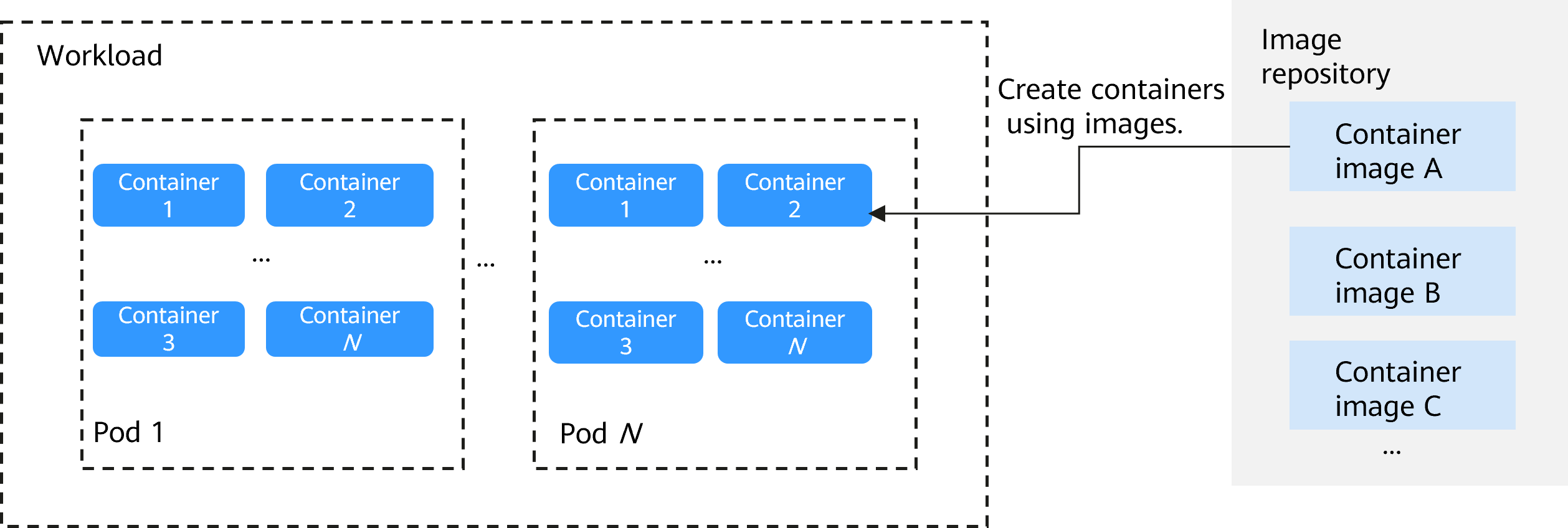
- A workload is an application running on one or more pods. A pod consists of one or more containers. Each container is created from a container image.
The following figure shows the relationships between images, containers, and workloads.
Figure 1 Relationships between images, containers, and workloads