When deploying applications in a CCE cluster, you typically need persistent object storage for service data. Without dynamic provisioning, you must manually create a bucket on the OBS console and define a PV and PVC in the cluster. This process is complex. To simplify this, you can use dynamic volume provisioning: declare a StorageClass in your PVC, and OBS buckets are automatically created with PVs generated and bound on demand. This enables pay-per-use, on-demand object storage. This section describes how to use object storage through dynamic PVs in CCE.
How It Works
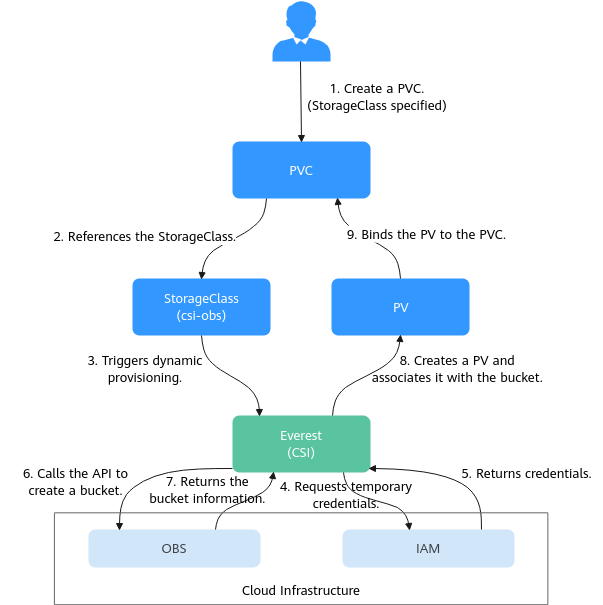
Dynamic OBS volume provisioning is an automated process managed by the Everest CSI driver, which handles bucket creation, PV generation, and binding. The core process is as follows.
Dynamic Provisioning for OBS Buckets | Description |
|---|---|
|
|
Constraints
- If OBS volumes are used, the owner group and permission of the mount point cannot be modified.
- Every time an OBS volume is mounted to a workload through a PVC, a resident process is created in the backend. When a workload uses too many OBS volumes or reads and writes a large number of object storage files, resident processes will consume a significant amount of memory. To ensure stable running of the workload, make sure that the number of OBS volumes used does not exceed the requested memory. For example, if the workload requests 4 GiB of memory, the number of OBS volumes should be no more than 4.
- Secure containers do not support OBS volumes.
- Hard links are not supported when common buckets are mounted.
- Read-only is not supported when an OBS PVC is mounted to a workload.
- OBS allows a single user to create a maximum of 100 buckets. If a large number of dynamic PVCs are created, the number of buckets may exceed the upper limit, and no more OBS buckets can be created. In this case, use OBS by calling its API or SDK and do not mount OBS buckets to workloads.
Automatically Creating an OBS Bucket Using the Console
- Log in to the CCE console and click the cluster name to access the cluster console.
- Dynamically create a PVC and PV.
- Choose Storage in the navigation pane. In the right pane, click the PVCs tab. Click Create PVC in the upper right corner. On the slide-out panel, configure PVC parameters.
Parameter
Description
PVC Type
In this example, select OBS.
PVC Name
Enter the PVC name, which must be unique in a namespace.
Creation Method
- If no underlying storage is available, select Dynamically provision to create a PVC, PV, and underlying storage on the console in cascading mode.
- If the underlying storage is available, create a PV or use an existing PV to statically create a PVC. For details, see Using an Existing OBS Bucket Through a Static PV.
In this example, select Dynamically provision.
Storage Classes
The default StorageClass name of OBS volumes is csi-obs.
You can customize a StorageClass and configure its reclaim policy and binding mode. For details, see Basic StorageClass Settings.
(Optional) Storage Volume Name Prefix
Available only when the cluster version is v1.23.14-r0, v1.25.9-r0, v1.27.6-r0, v1.28.4-r0, or later, and Everest v2.4.15 or later is installed in the cluster.
This parameter specifies the name of the underlying storage that is automatically created. The actual underlying storage name is in the format of "Storage volume name prefix + PVC UID". If this parameter is left blank, the default prefix pvc will be used.
For example, if the storage volume name prefix is set to test, the actual underlying storage name is test-{UID}.
Instance Type
- Parallel file system: a high-performance file system provided by OBS. It provides millisecond-level access latency, TB/s-level bandwidth, and million-level IOPS.
- Object bucket: provides reliable, high-performance, secure, and budget-friendly storage for data. They have no restrictions on the quantity of files or storage capacity.
OBS Class
You can select the following object bucket types:
- Standard: Applicable when a large number of hotspot files or small-sized files need to be accessed frequently (multiple times per month on average) and require fast access response.
- Infrequent access: Applicable when data is not frequently accessed (fewer than 12 times per year on average) but requires fast access response.
Access Mode
OBS volumes support only ReadWriteMany, indicating that a storage volume can be mounted to multiple nodes in read/write mode. For details, see Volume Access Modes.
AK/SK
- Custom: Each IAM user uses their own access key (AK/SK). You can use IAM to control individual user permissions for accessing OBS. (This method is recommended.) For details, see Using a Custom Access Key (AK/SK) to Mount an OBS Volume.
Only secrets with the secret.kubernetes.io/used-by = csi label can be selected. The secret type must be cfe/secure-opaque. If no secret is available, click Create Secret.
- Name: Enter a secret name.
- Namespace: Select the namespace where the secret is.
- Access Key (AK/SK)
- Permanent: Upload a key file in .csv format. For details, see Obtaining Access Keys.
- Global access secret (paas.longaksk): All clusters use the account's AK/SK. This method is simple, but does not support fine-grained access control. If you create a global access key while using OBS volumes in a cluster, CCE creates a secret named paas.longaksk in the kube-system namespace to store the global AK/SK. This secret is project-scoped. Once a global access key is used, it is automatically provisioned for each cluster within the same project. You can disable the global access secret in Settings > Cluster Settings.
If the cluster does not use the global access secret, this option is not displayed.
CAUTION:If the AK/SK is deleted or disabled accidentally, the container cannot use the OBS volume.
Enterprise Project
An enterprise project manages multiple resources by category. Resources and projects across cloud service regions can be grouped into a single enterprise project. For example, an enterprise can classify resources by department or project group, and place relevant resources in the same enterprise project for unified management.
This parameter is available only for enterprise accounts with enterprise projects enabled.
Resource Tag
You can add resource tags to classify resources. This is supported only when the Everest version in the cluster is 2.4.204 or later.
NOTE:After a dynamic PV of the OBS type is created, the resource tags cannot be updated on the CCE console. To update OBS resource tags, go to the OBS console.
- Click Create to create a PVC and a PV.
You can choose Storage in the navigation pane and view the created PVC and PV on the PVCs and PVs tabs, respectively.
- Choose Storage in the navigation pane. In the right pane, click the PVCs tab. Click Create PVC in the upper right corner. On the slide-out panel, configure PVC parameters.
- Create an application.
- Choose Workloads in the navigation pane. In the right pane, click the Deployments tab.
- Click Create Workload in the upper right corner. On the displayed page, click Data Storage in the Container Information area under Container Settings and choose Add Volume > PVC.
Mount and use storage volumes. For details about the parameters, see Table 1. For other parameters, see Workloads.
Table 1 Mounting a storage volumeParameter
Description
PVC
Select an existing OBS volume.
Mount Path
Enter a mount path, for example, /tmp.
This parameter specifies a container path to which a data volume will be mounted. Do not mount the volume to a system directory such as / or /var/run. This may lead to container errors. Mount the volume to an empty directory. If the directory is not empty, ensure that there are no files that affect container startup. Otherwise, the files will be replaced, leading to container startup failures or workload creation failures.
NOTICE:If a volume is mounted to a high-risk directory, use an account with minimum permissions to start the container. Otherwise, high-risk files on the host may be damaged.
Subpath
Enter the subpath of the storage volume and mount a path in the storage volume to the container. In this way, different folders of the same storage volume can be used in a single pod. tmp, for example, indicates that data in the mount path of the container is stored in the tmp folder of the storage volume. If this parameter is left blank, the root path will be used by default.
Permission
- Read-only: You can only read the data in the mounted volumes.
- Read-write: You can modify the data volumes mounted to the path. Newly written data will not be migrated if the container is migrated, which may cause data loss.
In this example, the disk is mounted to the /data path of the container. The container data generated in this path is stored in the OBS volume.
- After the configuration, click Create Workload.
After the workload is created, the data in the container mount directory will be persistently stored. Verify the storage by referring to Verifying Data Persistence and Sharing.
Automatically Creating an OBS Bucket Using kubectl
- Use kubectl to access the cluster.
- Use StorageClass to dynamically create a PVC and PV.
- Create the pvc-obs-auto.yaml file.apiVersion: v1kind: PersistentVolumeClaimmetadata:name: pvc-obs-autonamespace: defaultannotations:everest.io/obs-volume-type: STANDARD # Object storage typecsi.storage.k8s.io/fstype: obsfs # Instance typecsi.storage.k8s.io/node-publish-secret-name: <your_secret_name> # Custom secret namecsi.storage.k8s.io/node-publish-secret-namespace: <your_namespace> # Namespace of the custom secreteverest.io/enterprise-project-id: <your_enterprise_project_id> # (Optional) Enterprise project ID of the new OBS volumeeverest.io/csi.volume-name-prefix: test # (Optional) Volume name prefix of the automatically-created underlying storagespec:accessModes:- ReadWriteMany # The value must be ReadWriteMany for OBS volumes.resources:requests:storage: 1Gi # OBS volume capacitystorageClassName: csi-obs # The StorageClass is OBS.Table 2 Key parameters
Parameter
Mandatory
Description
everest.io/obs-volume-type
Yes
OBS StorageClass.
- If fsType is set to s3fs, standard buckets (STANDARD) and infrequent access buckets (WARM) are supported.
- This parameter is invalid when fsType is set to obsfs.
csi.storage.k8s.io/fstype
Yes
Instance type. The value can be obsfs or s3fs.
- obsfs: a parallel file system
- s3fs: an object bucket
csi.storage.k8s.io/node-publish-secret-name
No
Custom secret name.
(Recommended) Select this option if you want to assign different user permissions to different OBS storage devices. For details, see Using a Custom Access Key (AK/SK) to Mount an OBS Volume.
csi.storage.k8s.io/node-publish-secret-namespace
No
Namespace of a custom secret.
everest.io/enterprise-project-id
No
The ID of the enterprise project in which the OBS volume is created. It is applicable only to enterprise accounts with enterprise projects enabled.
To obtain an enterprise project ID, log in to the EPS console, click the name of the target enterprise project, and copy the enterprise project ID.
everest.io/csi.volume-name-prefix
No
(Optional) This parameter is available only when the cluster version is v1.23.14-r0, v1.25.9-r0, v1.27.6-r0, v1.28.4-r0, or later, and Everest v2.4.15 or later is installed in the cluster.
This parameter specifies the name of the underlying storage that is automatically created. The actual underlying storage name is in the format of "Storage volume name prefix + PVC UID". If this parameter is left blank, the default prefix pvc will be used.
Enter 1 to 26 characters that cannot start or end with a hyphen (-). Only lowercase letters, digits, and hyphens (-) are allowed.
For example, if the storage volume name prefix is set to test, the actual underlying storage name is test-{UID}.
storage
Yes
Requested capacity in the PVC, in Gi.
For OBS, this parameter is only for verification. It must not be empty or 0, and its value is fixed at 1. Any value you set will not take effect.
storageClassName
Yes
StorageClass name, which is csi-obs for an OBS volume.
everest.io/obs-volume-tags
No
(Optional) This parameter is supported when the Everest version in the cluster is 2.4.204 or later.
You can add resource tags to classify resources.
You can create predefined tags on the TMS console. These tags are available to all resources that support tags. You can use these tags to improve the tag creation and resource migration efficiency.
- Run the following command to create a PVC:kubectl apply -f pvc-obs-auto.yaml
- Create the pvc-obs-auto.yaml file.
- Create an application.
- Create a file named web-demo.yaml. In this example, the OBS volume is mounted to the /data path.apiVersion: apps/v1kind: Deploymentmetadata:name: web-demonamespace: defaultspec:replicas: 2selector:matchLabels:app: web-demotemplate:metadata:labels:app: web-demospec:containers:- name: container-1image: nginx:latestvolumeMounts:- name: pvc-obs-volume # Volume name, which must be the same as the volume name in the volumes fieldmountPath: /data # Location where the storage volume is mountedimagePullSecrets:- name: default-secretvolumes:- name: pvc-obs-volume # Volume name, which is user-definedpersistentVolumeClaim:claimName: pvc-obs-auto # Name of the created PVC
- Run the following command to create a workload to which the OBS volume is mounted:kubectl apply -f web-demo.yaml
After the workload is created, you can try Verifying Data Persistence and Sharing.
- Create a file named web-demo.yaml. In this example, the OBS volume is mounted to the /data path.
Verifying Data Persistence and Sharing
- View the deployed application and files.
- Run the following command to view the created pod:kubectl get pod -n <namespace> | grep web-demo
Expected output:
web-demo-846b489584-mjhm9 1/1 Running 0 46sweb-demo-846b489584-wvv5s 1/1 Running 0 46s - Run the following commands in sequence to check the files in the /data path of the pods:kubectl exec -n <namespace> web-demo-846b489584-mjhm9 -- ls /datakubectl exec -n <namespace> web-demo-846b489584-wvv5s -- ls /data
If no result is returned for both pods, no file exists in the /data path.
- Run the following command to view the created pod:
- Run the following command to create a file named static in the /data path:kubectl exec -n <namespace> web-demo-846b489584-mjhm9 -- touch /data/static
- Run the following command to check the files in the /data path:kubectl exec -n <namespace> web-demo-846b489584-mjhm9 -- ls /data
Expected output:
static - Verify data persistence.
- Run the following command to delete the pod named web-demo-846b489584-mjhm9:kubectl delete pod -n <namespace> web-demo-846b489584-mjhm9
Expected output:
pod "web-demo-846b489584-mjhm9" deletedAfter the deletion, the Deployment controller automatically creates a replica.
- Run the following command to view the created pod:kubectl get pod -n <namespace> | grep web-demo
The expected output is as follows, in which web-demo-846b489584-d4d4j is the newly created pod:
web-demo-846b489584-d4d4j 1/1 Running 0 110sweb-demo-846b489584-wvv5s 1/1 Running 0 7m50s - Run the following command to check whether the files in the /data path of the new pod have been modified:kubectl exec -n <namespace> web-demo-846b489584-d4d4j -- ls /data
Expected output:
staticThe static file is retained, indicating that the data can be stored persistently.
- Run the following command to delete the pod named web-demo-846b489584-mjhm9:
- Verify data sharing.
- Run the following command to view the created pod:kubectl get pod -n <namespace> | grep web-demo
Expected output:
web-demo-846b489584-d4d4j 1/1 Running 0 7mweb-demo-846b489584-wvv5s 1/1 Running 0 13m - Run the command below to create a file named share in the /data path of either pod. In this example, select the pod named web-demo-846b489584-d4d4j.kubectl exec -n <namespace> web-demo-846b489584-d4d4j -- touch /data/share
Check the files in the /data path of the pod.
kubectl exec -n <namespace> web-demo-846b489584-d4d4j -- ls /dataExpected output:
sharestatic - Check whether the share file exists in the /data path of another pod (web-demo-846b489584-wvv5s) as well to verify data sharing.kubectl exec -n <namespace> web-demo-846b489584-wvv5s -- ls /data
Expected output:
sharestaticAfter you create a file in the /data path of a pod, if the file is also created in the /data path of the other pod, the two pods share the same volume.
- Run the following command to view the created pod:
Related Operations
You can also perform the operations listed in Table 3.
Operation | Description | Procedure |
|---|---|---|
Updating an access key | Update the access key of object storage on the CCE console. |
|
Viewing events | View event names, event types, number of occurrences, Kubernetes events, first occurrence time, and last occurrence time of the PVC or PV. |
|
Viewing a YAML file | View, copy, or download the YAML file of a PVC or PV. |
|
Editing Reclaim Policy | Modify the reclaim policy of a PV. |
|