Definitions
A full backup backs up all data at a certain time point.
An incremental backup backs up the changed data since the last full or incremental backup.
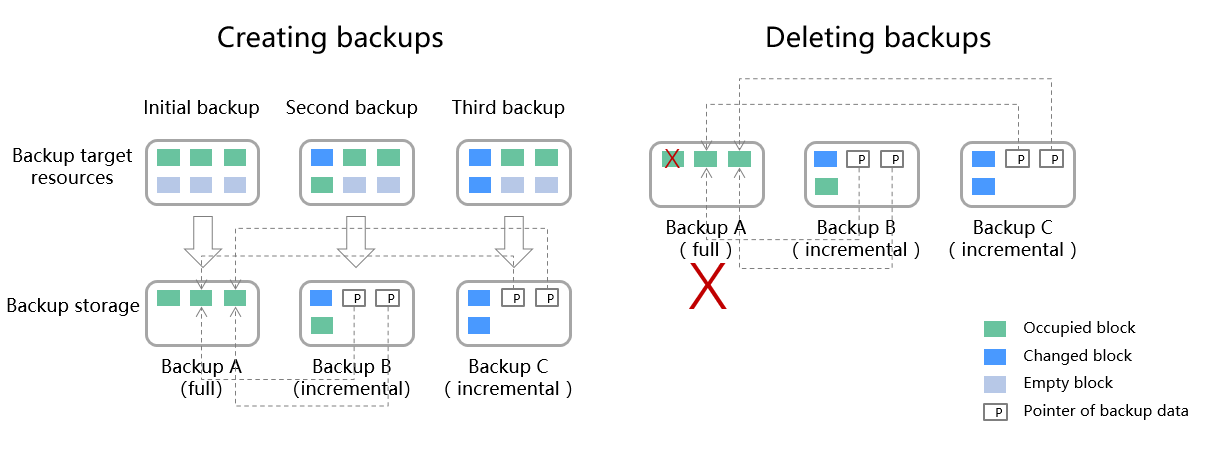
CBR uses the permanent incremental backup technology. A full backup is performed for a resource in the initial backup and incremental backups in subsequent backups. If a full backup expires and is deleted, its next incremental backup will be regarded as the resource's full backup.
Suppose that server X has backups A, B, and C. Backup A is a full backup, and backups B and C are incremental backups. Only changed data blocks are backed up in incremental backups and unchanged data blocks are referenced.
If backup A is deleted, only data blocks that are exclusive to backup A are deleted, and data blocks in backup A referenced by subsequent backups will not be deleted. Similarly, if backups A and B are deleted, backup C can also be used to restore data independently. There is no obvious difference between their restoration speeds.
Figure 1 Backup mechanism
Differences
- Backup duration: A full backup backs up the entire resource data which is usually larger than an incremental backup, so a full backup takes a longer time.
- Restoration duration: Both full backups and incremental backups can be restored. There is no obvious difference between their restoration speeds.
- Reliability: The latest incremental backup depends on the last full backup and intermediate incremental backups. If any backup data block is damaged, subsequent backups may be affected, which can deteriorate the backup reliability. All full backup data is independent and does not depend on previous backups. So full backups are more reliable.
It is recommended that you perform periodic full backups (for example, once every 30 days) together with daily incremental backups to shorten the incremental backup chain and improve the reliability of backup replicas.
In extreme cases, the size of a backup is the same as the disk size. The used capacity in a full backup and the changed capacity in an incremental backup are calculated based on data-block changes on the disk, rather than file-level changes in the operating system. As a result, the size of a full backup cannot be estimated from the file sizes in the operating system, and the size of an incremental backup cannot be estimated from file-level changes.