Unified Orchestration of Cloud Services
Currently, AOS allows unified orchestration of mainstream public cloud services. By creating stacks, applications and cloud resources of different types and configurations can be automatically created in batches. In this way, you can perform unified orchestration conveniently and efficiently.
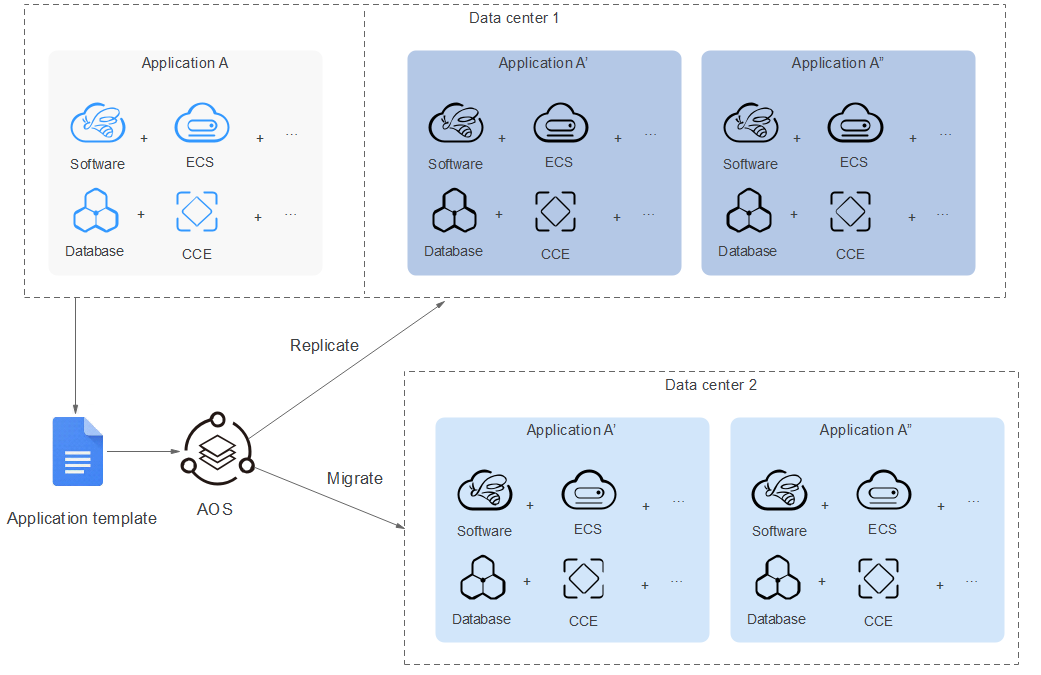
Fast Replication and Migration
AOS allows you to automatically replicate and migrate your business among different regions to ensure your business consistency across different environments. AOS templates allow you to delete and recreate resources and applications freely without any inconsistency. In this way, higher efficiency and reliability can be achieved.
User-Friendly Orchestration Language
- Both YAML and JSON syntax are supported when you are defining template elements.
- To define the configurations, number of instances, and operations of deployed objects, simply modify the input parameters. In this way, AOS enables you to reuse your templates conveniently.
- You can refer to variables, including input parameters, element attributes, and mapping tables during orchestration.
- Input parameter reference: used to obtain the values of input parameters defined in the inputs sections of template files.
- Element attribute reference: used to obtain the initialization results of the elements other than those in the inputs sections in a template. For example, when you are creating an ECS after creating a VPC, you can refer to the ID of the VPC you just created. This method can be used to build dependencies between resources and control the order of resource creation.
- Mapping table reference: used to obtain the content in mapping tables.
Graphical Template Designer
- AOS designer visualizes template structures and configurations, simplifying your compilation process. With the designer, orchestrated objects and their relationships can be clearly shown on canvases.
- The designer can be used together with templates, and stacks to improve user experience.
Parent topic: Service Overview